
A personal journey over the past 40 years of change in Cinema
Our memories, either collective or individual in nature are deeply personal to us, and it’s these memories that keep a potentially long gone era alive.
In this piece we’ll look at the past forty years of modern cinema, and the stark differences with society and the film industry, changing how and where we consume our beloved films.
So, why discuss the last forty years and not since the dawn of cinema? The answer to this is really quite simple; I wasn’t alive in 1895! That’s right folks, cinema first started it’s journey in society well over a century ago in France.
My experiences with cinemas is a long one, but not that long! I won’t bore you with deeply rooted anecdotes, and this little ditty won’t be a laborious history piece but there will be a few stories that may just make you smile, if not chuckle.
My very first experience with going to cinema (in the UK we commonly refer to the cinema as ‘The Pictures’), was back in 1982 in my home town of Crewe, Cheshire. I queued with my mother and my aunt to see the film of the year, and that was E.T. The Extra Terrestrial. Why is this relevant? Let me ask you, when was the last time you went to see a film, and the queue was so long, it spanned two whole blocks, and people had to wait up to eight hours to get in to watch a film? In all of my adult years, I have never once seen that happen. That’s not to see it hasn’t happened, but I have never witnessed that outside of childhood.
Back in the day people would queue for extraordinary lengths of time to make sure they experienced the big film of the year, and this is exactly what we did. I was 7 years old, and it was a gruelling 4 hours wait.
This marks the first difference in what I would classify as a decline in attendance compared to today. While not a wholly fair statement to make, simply because the screens and the seating were much smaller than modern halls, it’s still a long gone by-product of going to the flicks!
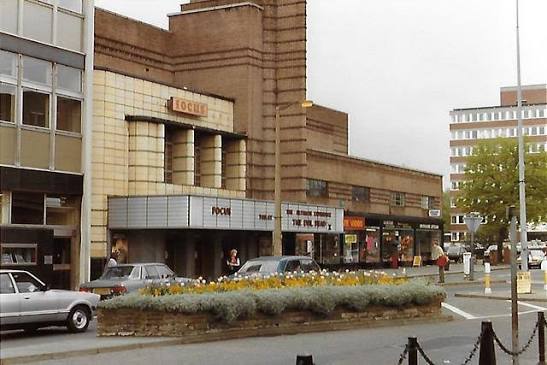
The Focus Cinema in Crewe, 1980.
Very few cinemas these days attempt to look like an old cinema, with most of them now owned by chains, rather than independent operators. And so the facias of cinema today are littered with giant posters rather than the haphazardly placed plastic lettering some old chap would spend hours arranging above the entryway. This has been lost to time. This for me, is a real shame, and cinemas lost something deeply personal here.
1990, and this year brought us Total Recall starring Arnold Schwarzenegger, a tent-pole event that everyone was flocking to see. This included myself and my best friend Richard. I won’t mention his surname, purely to keep Mr Kelly’s anonymity intact.
We were 15 and 16 respectively, way too young to be attending a 18 rated movie. So, we decided the best way to ensure we got in to see this behemoth of a film was to dress in suits, and attempt to look much older than we were. In reality, we looked like total idiots, and upon entering the ticket area, we both got a chuckle, smile and nod from the lady behind the counter. Tickets acquired…we were in!
Later that year, I was in Plymouth on a small weekend holiday with my parents. My mother gave me a whopping £20 and said the day was mine. So, I went off, bought some Marlboro cigarettes, and ventured into town. Right in the centre I found a huge cinema, and it was still showing Total Recall. The choice was again made to attempt to get in to see it. Feeling very brave and somewhat confident, I wandered inwards, bought a ticket, and even a pint of beer (yes, I was very rebellious and cared little for rules), and sat in the largest cinema space I had ever seen. One side had green coloured seats, with the other side, red in colour. I was the only one in there. I had the cinema all to myself!
I asked the attendant what was the purpose behind the coloured seating, and he informed me, one area was for smoking, the other for non smokers. I was perplexed and amazed at the same time. Never had I seen anything like this! I settled in, drank my illegally acquired booze, watched a film a definitely shouldn’t have been able to attend, and smoked a cigarette or three.
Here’s my point…the customs and acceptances of yesteryear were so vastly different to today, and it’s almost impossible to imagine it now. Yes, there are cinemas where you can buy your pint or a glass of wine and sit and watch your film, but smoking? And who thought that colouring the seats green would prevent smoke from wafting over? So, we lost the ability to smoke in a cinema, and I for one am glad that’s the case. I no longer smoke. It’s a filthy habit and I think it’s loss in your local cinema was a positive step forwards.
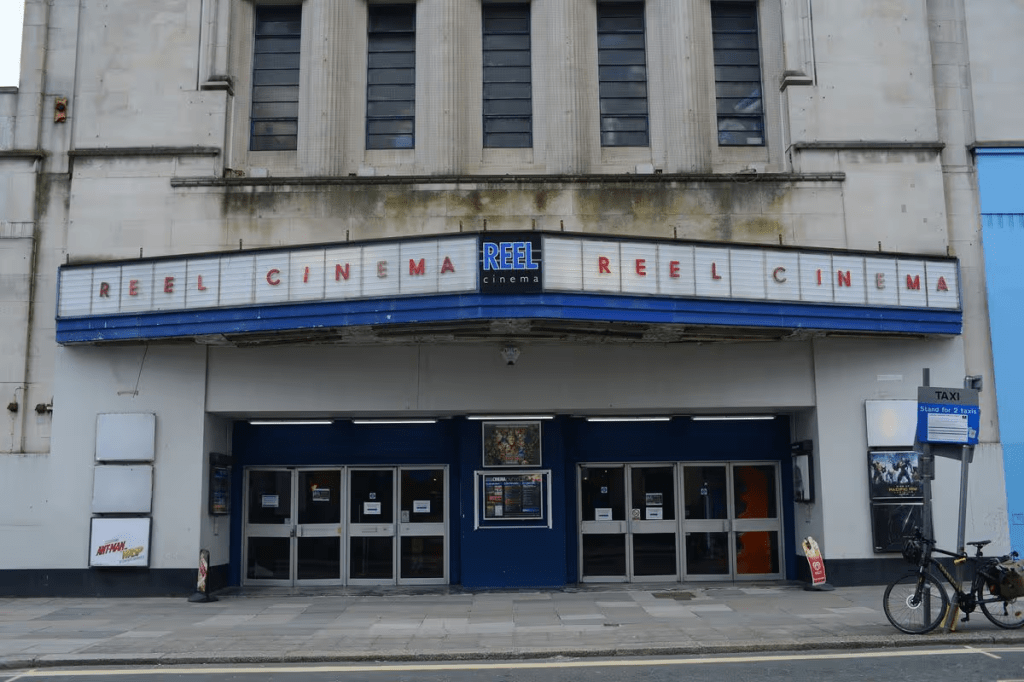
The Reel / ABC Cinema in Plymouth
Another change, before we tackle the major differences, is the seating. Who of us are old enough to remember the very tight, very stiff and uncomfortable seating in the cinema? Those seats that make your backside so numb, 3 days later you still can’t feel your posterior and starting to wonder if you should book a doctors appointment?! Pretty much, all gone, and while I should be very happy at this, I still find modern seating to be quite uncomfortable after 20 minutes. It all looks very inviting and luxurious, but don’t believe the lie! OK, this may be a small exaggeration, but I do genuinely believe we have not advanced that far in how we remain comfortable while enjoying our films. I welcome the changes, but more needs to be done in my very humble opinion.
So, the big changes then.
How film has been projected is arguably the greatest change in the past forty years of cinema.
Back in the 70’s and 80’s, cinema’s projected film either in 35mm or 70mm formats. While in the 70’s, 35mm film stock was more abundantly in use, the 70mm format soon took over, offering cinemas a chance to upgrade to much wider screens. However, the projectors for 70mm were very expensive, and many film-makers preferred 35mm stock because the audio was built into the film track, whereas 70mm needed a separate DTS disc to sync the audio alongside the film. 70mm soon became the standard for IMAX, and 35mm kept on being produced.
Today, most cinemas use digital projectors to show their films. And the math behind this decision is easy to understand, even if we don’t necessarily agree with it. For instance, it costs around £50,000 to film using just one reel of 70mm. Now factor that cost from 9 to 12 depending on the length of the film. It’s quite the sum of money! And 35mm is also costly when using to film. Cutting this cost where the studios are concerned, is an easy choice to make.
The other issue, is that film scratches so very easily and makes reshowing a slightly damaged film almost impossible. And next, are the reels. With around 9 reels of footage per film, you can expect a 35mm print to stretch in access of 2000 feet per reel! Oppenheimer, filmed in 70mm, stretches over 11 miles in length.
And while many cinemas resisted the implementation of digital projectors, as did film-makers, they are now becoming the norm with clearer and crisper imagery than ever before.
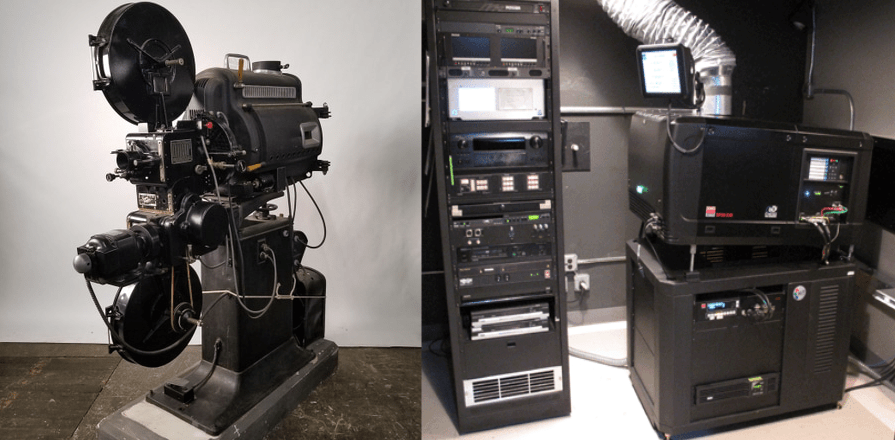
A typical 35mm projector, and a digital projector
I’m not a fan!
There’s something sterile about digital film. It lacks personality. Maybe I’m just set in my ways and far too used to the way things were. I love grainy film, I like how the fine details are softened by film stock, not thrust at you with a sharp stick by digital lamps. Yet here we are, standing on another precipice with LED walls on the horizon. Soon the humble screen will be sent off to the scrapyard, replaced with a wall of thousands of UHD lights.
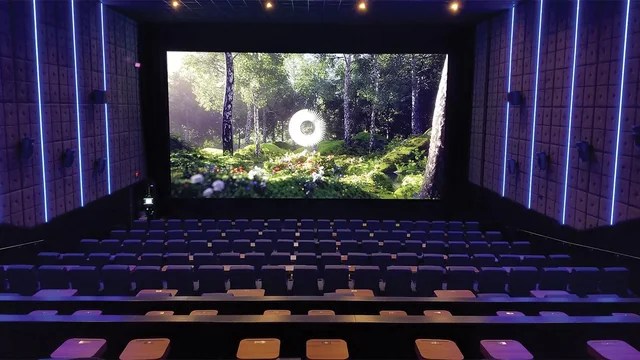
LED Screen in a modern cinema / Culver City, USA
And finally on this little journey of ours, is the final point I would like to raise, one that has it’s massive advantages over any cinema, and one disadvantage that doesn’t make it worth while. I am of course referring too Streaming.
The ability to watch the latest releases very quickly (outside of cinema) is via streaming services such as Netflix, Amazon Prime and many others. This is great for those who simply cannot make it to a cinema because at least you’ll be able to enjoy those films when logistics, time and money play major factors. And for the whole family to sit in the comfort of your own home and watch the same content for just one monthly price is a no-brainer, right?
Going to the cinema is not an especially cheap endeavour these days, I get that. The food can be expensive, some cinemas charge much more for what they consider to be premium seating, and getting there may be difficult.
But…and here’s the ‘but’ folks…going to the cinema, is and should always be, an event!
Going to the cinema with friends and family, perhaps on a date for the first time, or just going on your own to enjoy some ‘you time’ is a cultural staple that should be embraced. The feel of the ticket in your hand, the bustle into the room with a hundred fellow like minded individuals. The screams and roars at pivotal parts of the film where we all experience the same moment, on the largest screen in town, with the loudest speakers in town.
I’ll never forget the cheers and happiness I saw when the Star Wars Episode One title crawl started way back in 1999. It was deafening, surreal and utterly mesmerizing. OK the film was utter tosh, but that moment stayed with me forever. The same happened when I went to see Avengers: Endgame, and Captain America, standing tall with all the other ‘blinked’ superheroes as he says the immortal words ‘Avengers…Assemble!‘. The room ignited with cheers and screams; I felt it then too.
Cinema outings are a unique event, one where we get to spend time with others, because ultimately it’s a community setting. We experience the same highs and lows as everyone else. The tactile nature of going there, watching the film, enjoying popcorn and a big drink, and forgetting the outside world is as important back in the 80’s as it should be now. Just for a few hours, you can feel that you belong to something much larger than yourself.
But more importantly, it’s the memories we make on a night or afternoon out. It’s those moments you’ll never capture at home on the couch in front of your TV, no matter the size of the screen.
Cinema has changed, and will continue to change for as long as it’s around. Technologies will advance, both on-screen and behind. But what never changes is the human element of it all. What a wonderful way to enjoy escapism!
Thanks for reading, and if you enjoyed this, perhaps you’ll enjoy Martin’s take on that burning question; Are cinema snacks too expensive? Link is below!

You must be logged in to post a comment.